
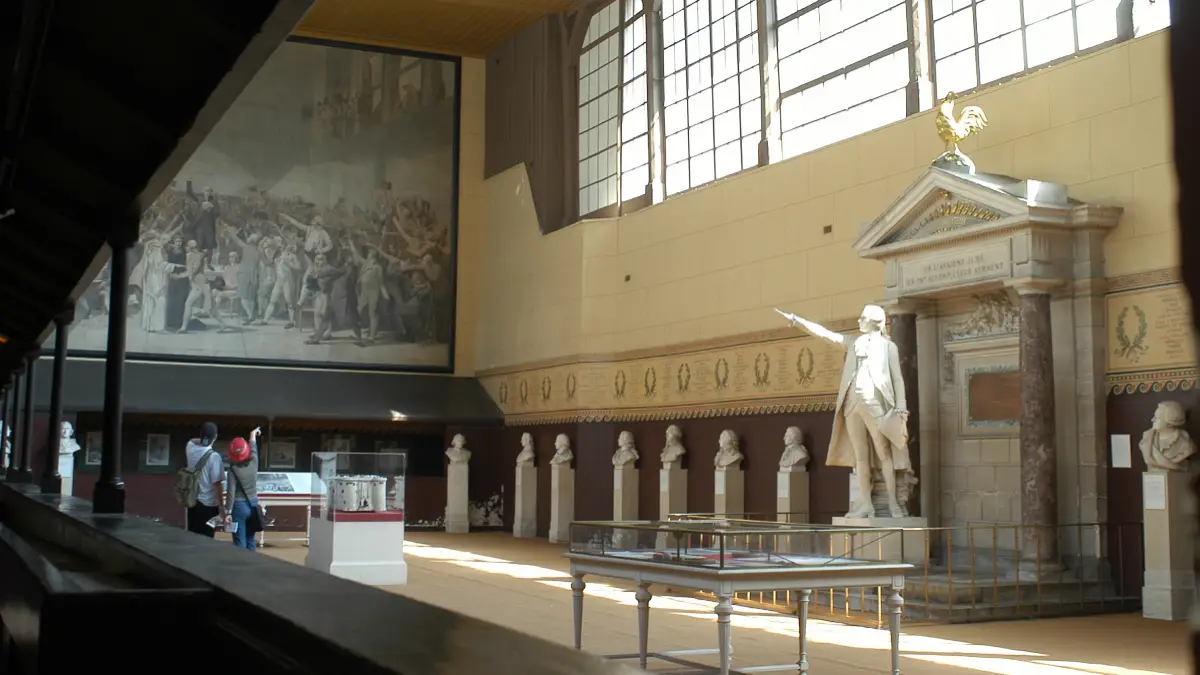
The Royal Tennis Court (Jeu de Paume) at Versailles was built in 1686 for the game of jeu de paume, an early form of real tennis. It became one of the defining sites of the French Revolution on 20 June 1789, when members of the Third Estate gathered here and swore not to disperse until a new French constitution had been established — the Tennis Court Oath. The court is a 10-minute walk from the main palace, open Tuesday to Sunday 12:30–5:30 pm, and entry is free. Guided tours are available.
The Royal Tennis Court is one of the most historically charged rooms in France — and one of the most overlooked. While millions visit the Hall of Mirrors, fewer make the 10-minute walk to this austere, high-ceilinged room where the French Revolution effectively began. The Tennis Court Oath of 1789 was the moment when commoners first challenged royal authority with a formal collective declaration, and this room is where it happened. Here’s everything you need to know.
Top Tickets
Table of Contents
History of the Royal Tennis Court
Built for Jeu de Paume (1686)
The court was built in 1686 during the reign of Louis XIV for the game of jeu de paume — a precursor of modern tennis, played with the palm of the hand (later with a racket) against a ball off the walls and roof of an enclosed court. The sport was enormously popular among the French nobility, and Louis XIV was himself an enthusiastic player in his youth.
The building was designed as a large rectangular hall, 32 metres long and 11 metres wide, with a high vaulted ceiling and tall windows along one side to admit natural light — essential for a sport played at speed. Galleries ran along the upper walls for spectators.
The Tennis Court Oath — 20 June 1789
On 20 June 1789, the course of French history changed in this room. The Third Estate — representatives of the common people, as distinct from the clergy and nobility — had been meeting at Versailles as part of the Estates-General convened by Louis XVI to address France’s financial crisis. When they arrived at their usual meeting room in the palace on the morning of 20 June, they found it locked and guarded by royal soldiers.
Assuming (correctly) that the king was about to dissolve the assembly, the delegates marched to the nearest large building that could accommodate them: the Royal Tennis Court. There, 576 of the 577 deputies present signed an oath declaring that they would not disperse until they had established a new constitution for France. The lone dissenter was a deputy from Castelnaudary who believed the measure too extreme.
The oath was a watershed moment. It was the first formal act of collective defiance against the absolute monarchy — a claim by ordinary citizens to political sovereignty. Within weeks, the Bastille had fallen. Within three years, Louis XVI had been executed. The Tennis Court Oath marked the beginning of the end of the Ancien Régime.
The oath was commemorated in a famous unfinished painting by Jacques-Louis David, which the artist began in 1791 but never completed. The original sketch is held at the Musée Carnavalet in Paris; a large reproduction is displayed at the tennis court itself.
Architecture and What to See
The building’s architecture is deliberately austere — plain stone walls, wooden-beamed ceiling, large windows. This simplicity makes it easy to imagine the chaotic scene of June 1789, when 576 men crowded into a sports hall and swore an oath that would transform France.
Inside the court today, visitors can see:
- The plaque commemorating the Tennis Court Oath, installed on the wall where the delegates gathered
- A reproduction of Jacques-Louis David’s sketch of the oath, showing the scene as David conceived it (with many of the 576 signatories identifiable by name)
- Interpretive exhibitions on the French Revolution and the context of the oath — why the Estates-General was called, who the Third Estate were, and what the oath achieved
- The original architectural features of the 1686 jeu de paume court, carefully restored to maintain the building’s 17th-century character
Visiting Information
| Detail | Information |
| Location | Rue du Jeu de Paume, 78000 Versailles — a 10-minute walk from the main palace |
| Opening hours | Tuesday to Sunday, 12:30 pm – 5:30 pm (last entry 5:00 pm) |
| Entry | Free (no ticket required) |
| Guided tours | Available; check en.chateauversailles.fr for schedule and booking |
| Photography | Permitted (no flash) |
| Accessibility | Ground floor accessible; contact palace for specific requirements |
The Royal Tennis Court is free to enter and does not require a standard Versailles palace ticket. It is open Tuesday to Sunday and can be visited independently of the main palace. Allow approximately 30–45 minutes for a self-guided visit; guided tours take around 60 minutes and provide considerably more historical depth.
How to Reach the Tennis Court
From the main palace entrance, walk north along the Rue de l’Indépendance Américaine for approximately 10 minutes. The Tennis Court is a modest-looking building set back slightly from the street — follow the directional signs from the palace. It is also visible on the palace map available from the Dufour Pavilion information point.
Frequently Asked Questions
Is the Tennis Court included in the Versailles ticket?
No — the Royal Tennis Court is free to enter and does not require a Versailles palace ticket. It is open independently of the main palace, Tuesday to Sunday from 12:30 pm to 5:30 pm.
Why is the Tennis Court Oath historically important?
The Tennis Court Oath of 20 June 1789 was the first formal act of collective defiance against the French absolute monarchy. By swearing not to disperse until a constitution had been established, the deputies of the Third Estate asserted that political sovereignty belonged to the people, not the king. It was the opening act of the French Revolution.
