
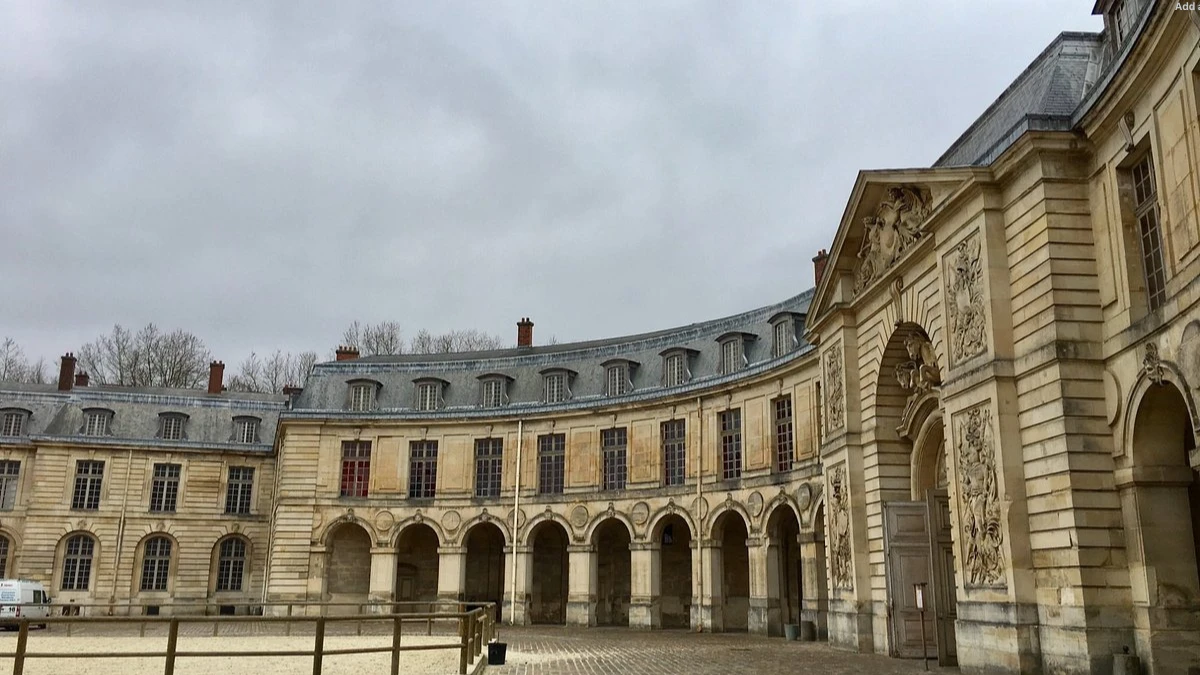
The Royal Stables of Versailles consist of two buildings — the Great Stables and the Small Stables — located directly opposite the palace across the Place d’Armes. Built by Jules Hardouin-Mansart between 1679 and 1682, they once housed up to 2,000 royal horses. Today the Great Stables contains the Gallery of Coaches (open weekends and school holidays) and the Equestrian Academy of Versailles. The Small Stables houses the Sculptures and Mouldings Gallery. Both galleries are included in the Full Access Ticket.
Visitors to Versailles often walk straight past the Royal Stables without realising they exist. Located directly opposite the palace across the Place d’Armes, these two monumental buildings are architectural masterpieces in their own right — and today house two of the least-crowded galleries on the entire estate. Here’s what to see and when to visit.
Top Tickets
Table of Contents
History: The Great and Small Stables
The Royal Stables were commissioned by Louis XIV and designed by architect Jules Hardouin-Mansart — the same architect responsible for the Hall of Mirrors, the Royal Chapel, and the Grand Trianon. Construction took place between 1679 and 1682, and the two buildings were completed simultaneously. Despite their similar names, the distinction between them was one of function, not size:
- The Great Stables (Grande Écurie) — housed the royal saddle horses used by the King, Queen, and high-ranking courtiers for riding and ceremonies; at its peak it contained around 2,000 horses brought from Spain, Arabia, and Persia
- The Small Stables (Petite Écurie) — housed the coach horses and their carriages; despite the name it is architecturally the same scale as the Great Stables
Together, the two buildings could accommodate over 6,000 horses in total during the height of court life at Versailles.
The Great Stables Today
Gallery of Coaches (Galerie des Carrosses)
The Gallery of Coaches is the principal visitor attraction in the Great Stables. It houses a remarkable collection of royal carriages, sleighs, and ceremonial vehicles from the 18th and 19th centuries, including:
- The Coronation Coach of Charles X (1825) — one of the largest and most ornate ceremonial carriages in the collection
- The Coronation Coach of Napoleon III — used for the imperial coronation ceremonies of the Second Empire
- A selection of royal berlines, calashes, and landaus spanning the reigns of Louis XV, Louis XVI, and Napoleon I
- Children’s carriages and royal sleighs from the 18th century
| Season | Days | Hours |
| High season (Apr–Oct) | Saturdays, Sundays, and Zone C school holidays (Tue–Sun) | 12:30 pm – 6:30 pm |
| Low season (Nov–Mar) | Weekends only | 12:30 pm – 5:30 pm |
The Gallery of Coaches is included in all standard Versailles tickets. It is consistently one of the quietest galleries on the estate — very few visitors make the short walk across the Place d’Armes to find it.
Equestrian Academy of Versailles
The Écurie du Roi — Equestrian Academy of Versailles (formerly the Bartabàs Academy) continues the tradition of classical horsemanship in the Great Stables. Performances of baroque equestrian art take place in the arena of the Great Stables, with horses and riders trained in the classical French riding tradition. Check en.chateauversailles.fr for the 2026 performance schedule and tickets.
Campus Versailles
Since 2024, the Great Stables also house Campus Versailles — an initiative dedicated to teaching the traditional crafts involved in the creation and restoration of Versailles: gilding, ironwork, fresco painting, stonecutting, cabinet-making, and tapestry. It includes the National School of Architecture of Versailles and the Centre for Research and Restoration of French Museums. Campus Versailles is not generally open to casual visitors but represents an important part of the palace’s long-term conservation mission.
The Small Stables Today
Sculptures and Mouldings Gallery
The Small Stables houses the Sculptures and Mouldings Gallery — a collection of original sculptures from the Palace of Versailles and the Louvre, alongside plaster casts of classical Greek and Roman statues from the late 17th century. Many of the original garden sculptures at Versailles have been replaced by copies to protect them from weathering; the originals are displayed here.
The gallery is open every Saturday and Sunday from 12:30 pm to 6:30 pm year-round. Entry is included in standard Versailles tickets. The courtyard of the Small Stables — the Royal Stables Courtyard — is also open to wander through and offers a quiet, less-visited corner of the estate with an impressive view of both stable buildings’ facades.
Visiting Tips
- The stables are across Place d’Armes, directly opposite the main palace entrance — a 2-minute walk; easy to combine at the end of a palace visit
- The Gallery of Coaches is weekends-only outside school holidays — check hours before visiting on a weekday
- Both galleries are far less crowded than the main palace — a pleasant contrast after the Hall of Mirrors
- The Royal Stables Courtyard is accessible independently and makes for good architectural photography
FAQs
Here are some of the frequently asked questions about The Royal Stables.
Can I visit the stables at Versailles?
Yes! Once a place reserved for royal and draft horses, now the Great Stables and Small Stables house galleries and institutions.
You can book your tickets online.
Is there an extra fee to visit the Royal Stables?
The Royal Stables are included in the Palace of Versailles entry ticket.If you book a Versailles Guided Tour, you can visit the Stables at your own pace either before or after your guided tour.
What are the Royal Stables of Versailles?
The Royal Stables were built as a home for the horses used by the Royals.
Today, the Stables accommodate the National School of Architecture of Versailles, a segment of the Centre for Research and Restoration of the Museums of France, and the Equestrian Academy of Versailles.
Visitors can explore the Gallery of Coaches in the Great Stables and the Sculptures and Mouldings Gallery in the Small Stables.
What can I see at the Royal Stables?
The stables have historic carriages, harnesses, and other horse equipment.
They also have exhibits about the stables’ history and their role in the French court.
When were the Royal Stables built?
The Stables were built between 1679 and 1682, during King Louis XIV’s reign.
