
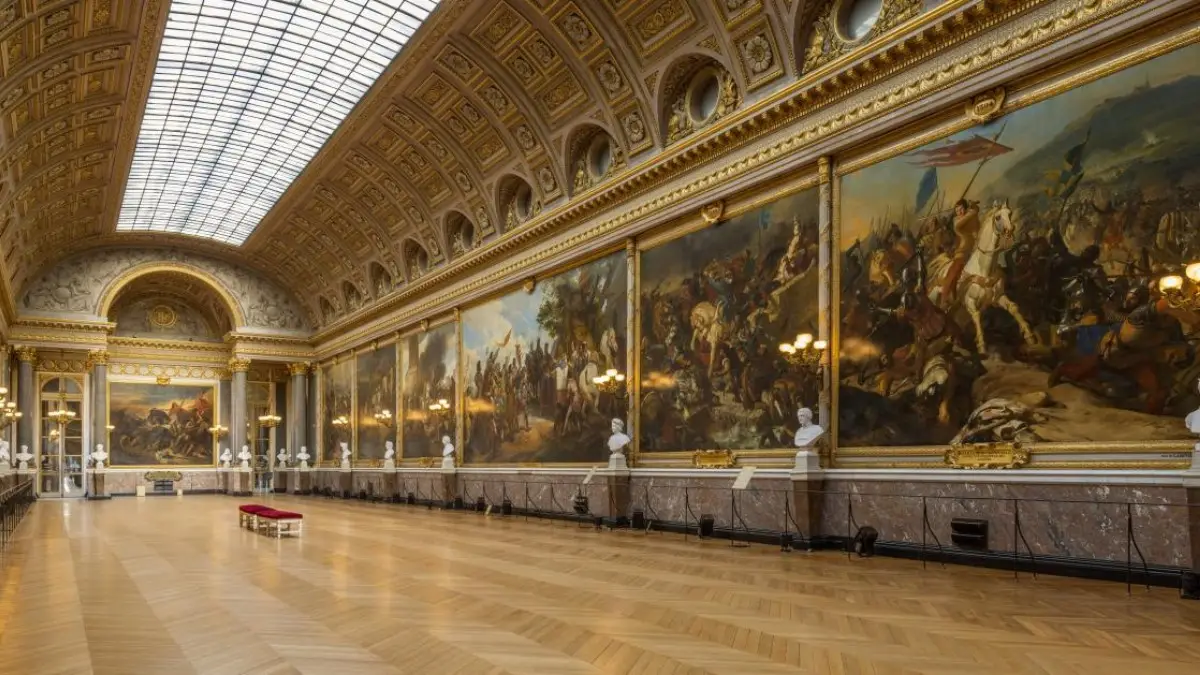
The Gallery of Great Battles (Galerie des Batailles) is the largest room in the Palace of Versailles — 120 metres long and 13 metres wide, spanning almost the entire first floor of the South Wing. Commissioned by King Louis-Philippe and opened on 10 June 1837, it houses 33 monumental paintings depicting French military victories from the Battle of Tolbiac (496 AD) to the Battle of Wagram (1809), alongside 80 busts of fallen officers and bronze tablets listing 3,000 names. It is included in all standard Versailles tickets and is consistently one of the quietest and most impressive rooms in the palace.
The Gallery of Great Battles is the most undervisited major room at Versailles — which is a strange state of affairs for a room that is 120 metres long and contains 33 of the most dramatic paintings in France. While the crowds concentrate in the Hall of Mirrors and State Apartments upstairs, the Gallery of Great Battles on the floor below is often nearly empty. Here’s what to see and why it’s worth the detour.
Top Tickets
Table of Contents
Overview: The Room Itself
The Gallery of Great Battles was conceived by King Louis-Philippe as part of his transformation of Versailles into the Museum of the History of France in 1837. Architect Pierre-Léonard Fontaine designed the gallery’s structure to evoke the grandeur of the Louvre’s Grande Galerie: columns, glass ceilings, marble and gold decoration, and a vast open space that allows the enormous paintings to be seen from a distance.
The gallery occupies almost the entire first floor of the South Wing, running 120 metres east to west. At 13 metres wide and under a coffered barrel-vaulted ceiling, the space itself is monumental before you even look at the paintings. The gallery opened on 10 June 1837 and has remained largely unchanged since — all original artworks are still in place.
The 33 Paintings: 15 Centuries of French Military History
The paintings cover French military history chronologically from the Battle of Tolbiac in 496 AD (Clovis’ victory over the Alemanni, which led to the conversion of France to Christianity) through to the Battle of Wagram in 1809 (one of Napoleon’s last great victories before his decline). The paintings span the Merovingian, Carolingian, Capetian, Valois, and Bourbon dynasties, as well as the Revolutionary and Napoleonic eras.
Notable works include:
- The Battle of Bouvines (1214) by Horace Vernet — Philip II Augustus’ victory over the Holy Roman Emperor; one of the founding moments of French national identity
- The Battle of Fontenoy (1745) by Horace Vernet — Louis XV’s great victory against the British and their allies during the War of Austrian Succession
- The Battle of Austerlitz (1805) by François Gérard — arguably Napoleon’s greatest tactical victory; one of the largest canvases in the gallery
- The Entry of Henry IV into Paris (1594) by Gérard — the triumphal entry that ended the French Wars of Religion
Many of the paintings were commissioned by Napoleon himself; others were commissioned by Louis-Philippe during the Restoration period. The combination of different patrons and eras means the gallery presents French military history through several different political lenses — a subtly revealing document of how successive French regimes chose to narrate their own past.
The Memorial Elements
The Gallery of Great Battles was designed not just as an art gallery but as a national pantheon. Alongside the paintings, visitors will find:
- 80 sculpted busts of officers who died in battle — arranged in niches between the windows along both sides of the gallery
- Bronze tablets listing the names of over 3,000 princes, constables, marshals, and admirals who were killed or wounded in the service of France from the Middle Ages onwards
The combination of monumental painting and individual memorial creates a distinctive atmosphere — at once triumphant and elegiac. It is one of the more emotionally resonant spaces in the entire palace.
How to Visit
| Detail | Information |
| Location | First floor of the South Wing; accessed from the Museum of French History ground floor or from the Coronation Room |
| Hours | Same as palace: Tue–Sun, 9 am – 6:30 pm (Apr–Oct), 9 am – 5:30 pm (Nov–Mar) |
| Entry | Included in all standard Versailles tickets |
| Recommended visit time | 30–45 minutes |
| Crowds | Consistently quiet — far fewer visitors than the main apartment route |
| Photography | Permitted (no flash) |
The Gallery of Great Battles is best visited after the Hall of Mirrors, following the staircase down to the South Wing. It is rarely crowded even on the busiest days — making it one of the most reliably pleasant spaces to visit in peak season.
