
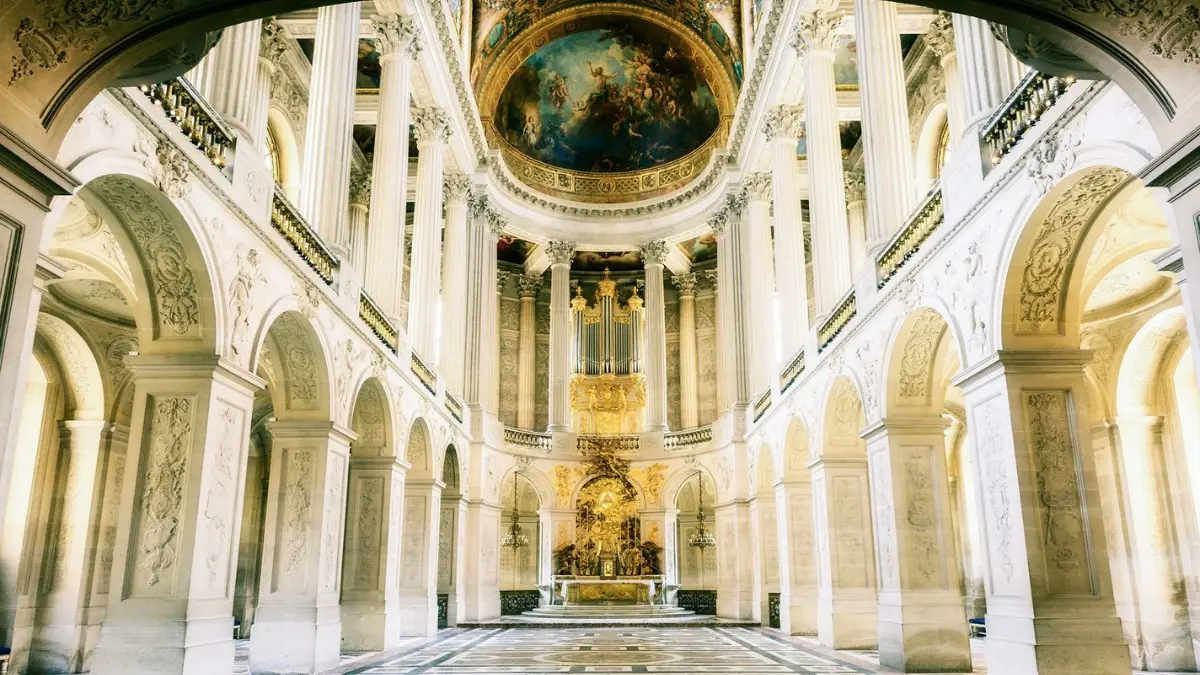
The Royal Chapel of Versailles (Chapelle Royale) was the last great building project of Louis XIV’s reign, completed in 1710 after over 20 years of construction. Standing 40 metres tall, it features a soaring vaulted ceiling covered in baroque frescoes, a golden pipe organ, Corinthian colonnades, and 30 stone statues on its facade. Royal masses were held here daily, and royal weddings and baptisms — including that of the future Louis XVI and Marie Antoinette — took place in this chapel. It is included in all standard Versailles tickets.
The Royal Chapel is often the biggest surprise for first-time visitors to Versailles. After the golden excess of the State Apartments and the grandeur of the Hall of Mirrors, stepping into the chapel feels like a different world entirely — lighter, more vertical, more spiritual. Louis XIV himself described it as his ‘finest and most difficult undertaking’, and after more than 20 years of planning and construction, the result justified every year of work.
Top Tickets
Table of Contents
History of the Royal Chapel
Versailles had several chapels before the current one — earlier versions were temporary structures within the palace body. Louis XIV wanted something permanent and worthy of his legacy. Construction of the final Royal Chapel began in 1689, designed by Jules Hardouin-Mansart (who also designed the Hall of Mirrors) and later completed by his brother-in-law Robert de Cotte after Mansart’s death in 1708. The chapel was officially dedicated on 5 June 1710 — just five years before Louis XIV’s own death.
The chapel stood at the symbolic and practical centre of court life. Every morning at 10 am, the entire court gathered for the king’s mass — a daily ritual that reinforced both the religious and the royal order. The king would descend from his apartments via a private corridor and appear in the royal gallery above the nave, visible to all below.
Major royal events took place in the chapel throughout the 18th century, including the marriage of the future Louis XVI and Marie Antoinette in 1770, and the baptisms of several royal children. During the Revolution, the chapel was stripped of much of its decoration, though the frescoes and the organ survived intact.
Architecture: What to Look For
The Exterior
The chapel’s exterior is immediately distinctive — its soaring roofline reaches 40 metres, making it visible from across the Cour d’Honneur. The façade features 30 stone statues representing Christian saints and virtues, including Saint Ambrose and Saint Andrew, created by 16 different sculptors. Inspired by ancient classical design, Corinthian pilasters add elegance and verticality. The original roof was decorated with gilded lead work — the lantern was removed in 1765.
The Interior
Inside, the chapel is divided by a two-level arrangement: the royal gallery at upper level (where the king and royal family sat, facing the altar) and the ground floor nave, where the court ladies occupied side balconies and others stood in the parterre.
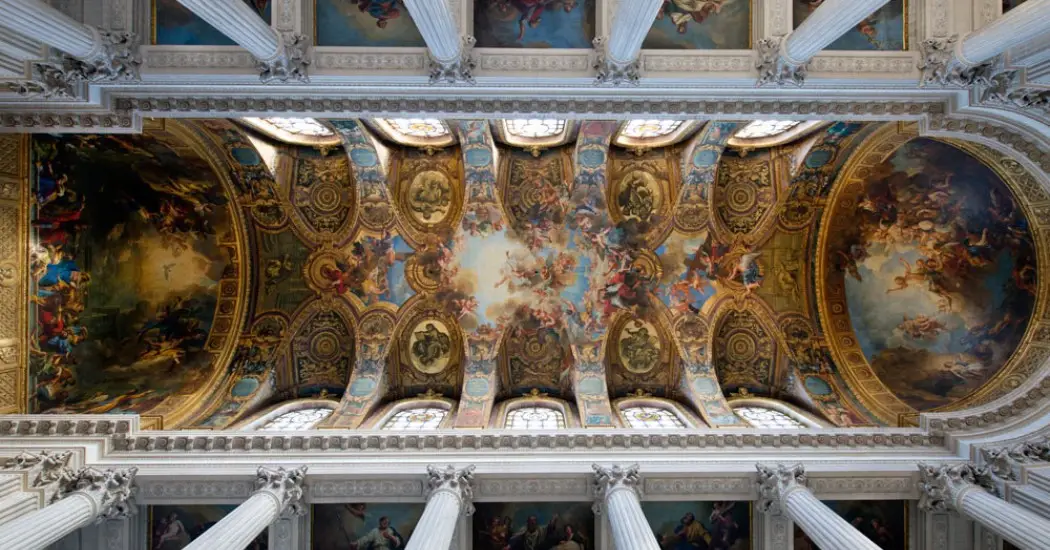
The vaulted ceiling is uninterrupted and covered in three major frescoes:
- God the Father in His Glory by Antoine Coypel — in the nave vault
- The Resurrection of Christ by Charles de La Fosse — in the apse above the altar
- Pentecost by Jean Jouvenet — in the royal gallery vault
The effect of these ceiling paintings, combined with the tall stained-glass windows flooding the interior with light, creates an atmosphere genuinely unlike anything else in the palace.
The Organ
The golden pipe organ faces the royal gallery and is one of the finest surviving baroque organs in France. It was installed at the chapel’s dedication in 1710, and François Couperin — one of the greatest French composers of the era — played at the opening ceremony. The organ case is decorated with a carved relief of King David, the musician-king of the Bible, positioned facing the royal gallery above. The organ is still used today for sacred music concerts, which make full use of the chapel’s extraordinary acoustics.
Music at the Royal Chapel
Music was central to the Royal Chapel from its founding. Couperin and many of the finest composers of Louis XIV’s court — Lully, Charpentier, Delalande — composed and performed sacred music here. Every Thursday, a formal concert of European sacred music from the 17th and 18th centuries was performed. The tradition continues today: the chapel hosts regular concerts of sacred and baroque music, offering a chance to experience the space as it was intended to be heard.
Visiting the Royal Chapel
The Royal Chapel is accessed from the North Wing of the palace via the Honour Courtyard and the grand staircase. It sits between the State Apartments and the main entrance, making it a natural first stop after passing through the entrance galleries. Allow approximately 30 minutes to explore the chapel properly.
The chapel is included in all standard Versailles tickets. Book the Full Access Ticket for self-guided access or the Guided Tour for expert commentary on the frescoes, the organ, and the historical significance of each section.
| Detail | Information |
| Location | North Wing of the main palace; via grand staircase from Cour d’Honneur |
| Completed | 1710 (construction began 1689) |
| Height | 40 metres |
| Architects | Jules Hardouin-Mansart; completed by Robert de Cotte |
| Key artists | Antoine Coypel, Charles de La Fosse, Jean Jouvenet (frescoes) |
| Recommended visit time | 25–30 minutes |
| Best time to visit | Mid-morning (after Hall of Mirrors); less crowded than main apartments |
| Included in | All standard Versailles tickets |
