
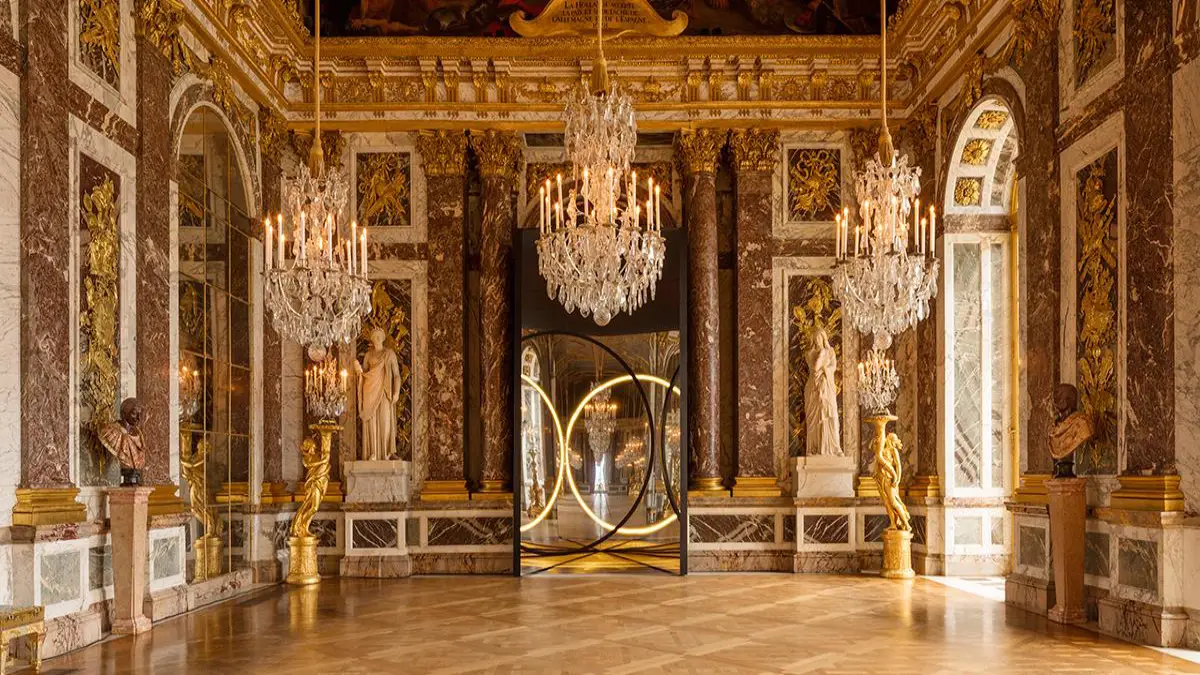
The King’s and Queen’s State Apartments are the ceremonial heart of the Palace of Versailles. The King’s suite consists of seven rooms, each named after a Roman god, running from the Hercules Room to the War Room adjacent to the Hall of Mirrors. The Queen’s Apartments mirror this arrangement on the opposite side of the Hall of Mirrors, culminating in the famous Queen’s Bedchamber where royal births took place. Both are included in all standard Versailles tickets.
The State Apartments are where the daily pageant of French royal life was performed — and the word ‘performed’ is deliberate. Louis XIV understood that visibility was power. His daily routines — rising, dining, going to bed — were conducted in these rooms before an audience of courtiers. Every detail of the decoration was designed to reinforce the divine authority of the king. Walking through these rooms today is to walk through the very theatre of absolute monarchy.
Top Tickets
Table of Contents
The King’s State Apartments
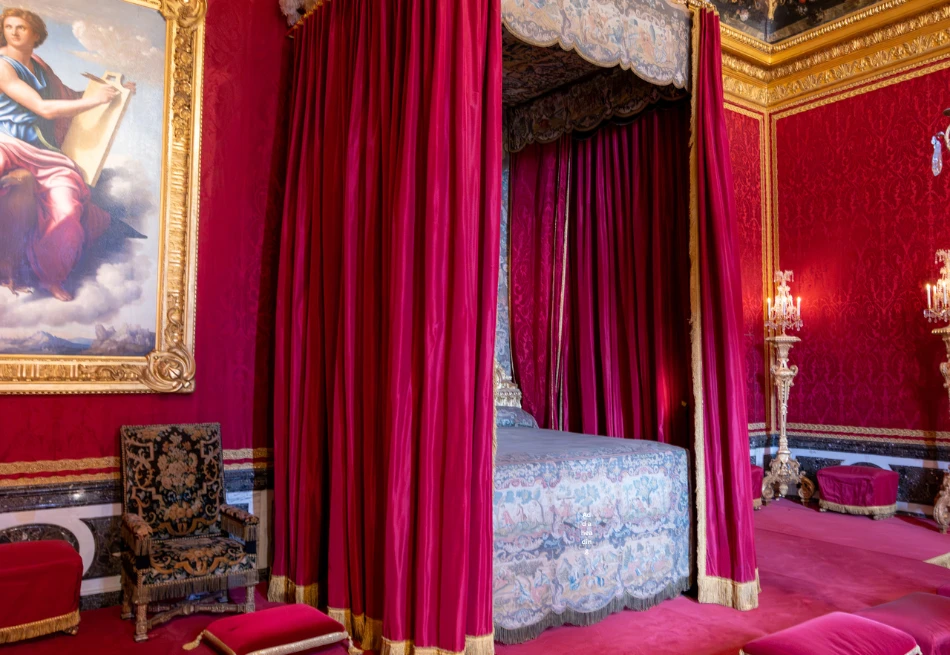
The Grand Appartement du Roi (King’s State Apartments) consists of seven rooms arranged in sequence along the north side of the palace. During Louis XIV’s reign, these rooms were open to the public on three evenings a week for appartement gatherings — evenings of music, gaming, and refreshments. Each room is named after a Roman deity and richly decorated with marble, gilded stucco, and painted ceilings.
Hercules Room (Salon d’Hercule)
The Hercules Room is the largest room in the King’s Apartments and the last to be completed — in 1736, under Louis XV. Its centrepiece is a monumental ceiling painting by François Lemoyne: The Apotheosis of Hercules, featuring 142 figures in a swirling baroque composition that took four years to paint. Tragically, Lemoyne took his own life the year after the room was completed, exhausted by the scale of the work. The room served as a connecting space between the Royal Chapel and the main apartments.
Venus Room (Salon de Vénus)
Originally serving as the entrance to the King’s apartments, the Venus Room was where refreshments were served during evening appartements. The walls are lined with marble and painted niches, and a painted ceiling depicts Venus enchanting the gods. A striking marble statue of the young Louis XIV stands at the centre, showing the king as a Roman emperor.
Diana Room (Salon de Diane)
Dedicated to the goddess of the hunt and the moon, the Diana Room served as a billiards room where Louis XIV himself played in full public view. The ceiling painting shows Diana in a celestial chariot; below, the billiards table was surrounded by courtiers watching the king’s game. A bust of Louis XIV by Bernini, considered one of the finest portraits of the king, is displayed here.
Mars Room (Salon de Mars)
The Mars Room served originally as a guardroom — the domain of the royal bodyguard — and later became a ballroom and concert hall. The dramatic red decor and imagery of war and armour reflect its martial dedication. The ceiling paintings depict Mars in a chariot drawn by wolves, and the room features bronze candelabras and royal portraits.
Mercury Room (Salon de Mercure)
The Mercury Room was the King’s ceremonial bedchamber — not where he actually slept, but the room where the formal lever (rising) and coucher (going-to-bed) ceremonies were performed before an audience of courtiers. The bed, richly decorated, was raised on a dais behind a balustrade. After Louis XIV’s death in 1715, his body lay in state in this room for nine days.
Apollo Room (Salon d’Apollon)
The Apollo Room, also known as the Throne Room, was the most important room in the King’s Apartments — where Louis XIV received ambassadors and foreign dignitaries seated on a silver throne, eight feet tall, on a raised platform. Louis identified himself with Apollo, the sun god, and this room was the symbolic centre of his power. The ceiling shows Apollo in his solar chariot, surrounded by the seasons and hours.
The Queen’s State Apartments
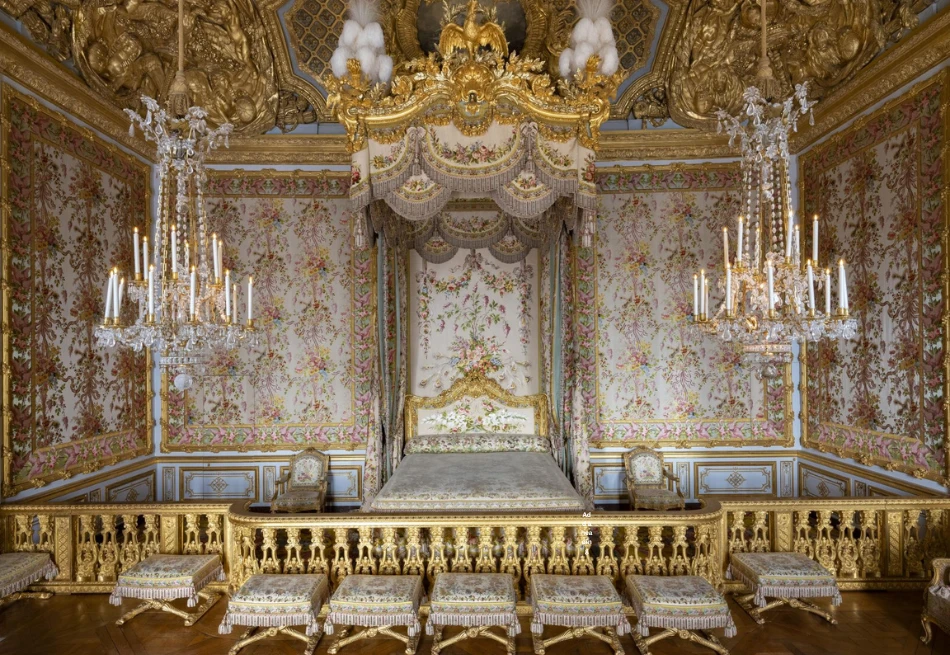
The Queen’s Apartments mirror the King’s suite on the opposite side of the Hall of Mirrors. They were used and modified by successive queens of France, most famously Marie Antoinette, who redecorated much of the suite in a lighter, neoclassical style from 1774.
Queen’s Antechamber
The first room visitors entered when meeting the queen, the Queen’s Antechamber was where the public Grand Couvert dinners were held — formal meals at which the entire royal family dined in public while courtiers looked on. Marie Antoinette found this ritual deeply uncomfortable and eventually had it discontinued.
Room of the Queen’s Gentlemen
This room served as a formal entry space for the queen’s inner circle of visitors. The decoration reflects the elegance of the queen’s apartments while serving a practical, transitional function.
Queen’s Bedchamber
The Queen’s Bedchamber is the most historically significant room in the Queen’s Apartments. This is where royal births took place — not in private, but before an audience of courtiers, to prove the legitimacy of royal heirs. The room was used by three queens and was modified most extensively by Marie Antoinette, who replaced the formal baroque furnishings with a lighter, more personal style. The state bed, richly canopied and embroidered, was the ceremonial focal point.
Queen’s Guard Room
The Queen’s Guard Room is the only room in the Queen’s Apartments to have retained its original 17th-century decoration — because the queen never actually used it, it was never modernised. Its historical authenticity makes it one of the most genuinely evocative spaces in the palace.
Marie Antoinette’s Private Cabinets
Hidden behind wood panels and silk hangings, Marie Antoinette’s private apartments spread across two floors behind her official State Apartment. These intimate rooms — a private library, boudoir, bathroom, and dressing room — were where she could escape the relentless performance of royal public life. She redecorated them from 1774 in a simpler neoclassical style, and only her closest friends and trusted servants were permitted entry.
Practical Information
| Detail | Information |
| Location | First floor, main palace body |
| Access | Included in all standard Versailles tickets |
| Recommended time | 60–90 minutes for both King’s and Queen’s Apartments |
| Best time to visit | Immediately after opening (9 am) for smallest crowds |
| Audio guide | Available from Dufour Pavilion; highly recommended |
Book your Full Access Ticket to visit both State Apartments, the Hall of Mirrors, the Royal Chapel, and the gardens in a single day. For a guided experience with expert commentary on each room, book the Skip-the-Line Guided Tour.
