
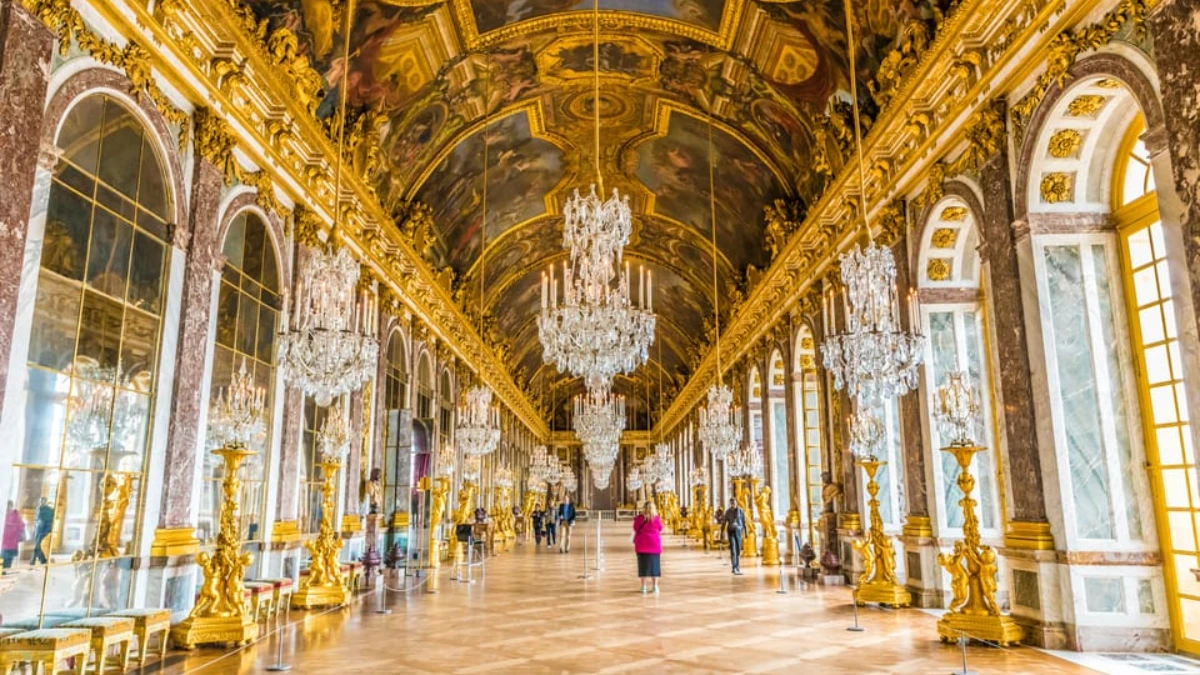
The Hall of Mirrors (Galerie des Glaces) is the most famous room in the Palace of Versailles. Designed by architect Jules Hardouin-Mansart and completed in 1684, it stretches 73 metres along the garden-facing side of the palace, with 357 mirrors set across 17 arched windows. The Treaty of Versailles, which ended World War I, was signed here on 28 June 1919. It is included in all standard Versailles tickets (from €21). Visit before 10 am for the quietest experience.
No single room in France is more photographed than the Hall of Mirrors. And yet, nothing quite prepares you for it. The sheer scale of the gallery — 73 metres long, 10.5 metres wide, 12.3 metres high — is breathtaking. The ceiling paintings, the gilded chandeliers, the mirrored light bouncing off every surface: it is, simply, extraordinary. Here’s everything you need to know before you visit.
Top Tickets
Table of Contents
Hall of Mirrors: Key Facts
| Detail | Information |
| French name | Galerie des Glaces / Grande Galerie |
| Location | First floor, central body of the palace |
| Length | 73 metres |
| Width | 10.5 metres |
| Height | 12.3 metres |
| Mirrors | 357, set across 17 arched windows |
| Built | 1678–1684 |
| Architect | Jules Hardouin-Mansart |
| Painter | Charles Le Brun (ceiling paintings) |
| Notable event | Signing of the Treaty of Versailles, 28 June 1919 |
| Workers involved | Approx. 30,000 |
| Visit duration | 20–30 minutes |
Why Is the Hall of Mirrors So Famous?
The Hall of Mirrors was not part of Louis XIV’s original plan — the site was previously a large outdoor terrace, designed by architect Louis Le Vau, which proved impractical in poor weather. Le Vau’s successor, Jules Hardouin-Mansart, proposed replacing it with an enclosed gallery. The result became the defining room of Versailles.
Creating 357 mirrors was a significant technological achievement in the 17th century. At the time, Venice held a monopoly on mirror production, and French glass was far inferior. Louis XIV commissioned craftsmen to entice Venetian mirror-makers to France — some sources suggest the Venetians sent assassins to reclaim their trade secret — and French mirror-making was transformed. The result was not just a beautiful gallery but a statement of French industrial and artistic supremacy.
The ceiling paintings by Charles Le Brun depict 30 scenes celebrating the reign of Louis XIV — diplomatic, military, and cultural victories. The gallery was used for royal receptions, masked balls, and grand ceremonies throughout the reign of the Louis family.
The Treaty of Versailles: 1919
The Hall of Mirrors’ most significant historical moment came on 28 June 1919, when the Treaty of Versailles was signed here by the Allied Powers and Germany, formally ending World War I. The choice of location was deliberate and symbolic.
In 1871, following France’s humiliating defeat in the Franco-Prussian War, Kaiser Wilhelm I was proclaimed Emperor of Germany in this very hall — a moment of profound national humiliation. Nearly 50 years later, French Prime Minister Georges Clemenceau chose the Hall of Mirrors to reverse that history, transforming the site of France’s greatest defeat into the room where Germany signed its surrender.
What You’ll See: A Room-by-Room Guide
The Hall of Mirrors Itself
Walking into the gallery, you’ll immediately notice the interplay of light and reflection. 17 arched windows face the gardens on the west side; each window is mirrored by a corresponding arch of mirrors on the east wall. The effect creates an infinite sense of depth and fills the room with natural light. Overhead, Le Brun’s ceiling paintings run the full length of the gallery, depicting scenes including France Triumphs Alone Over Germany and Spain and The King Governs by Himself.
The gallery once contained 150 silver furniture pieces — candelabras, vases, orange trees in silver tubs — all melted down by Louis XIV in 1689 to fund his wars. What you see today is the restored version, but still breathtaking: 20,000 candles in 357 gilded chandeliers and candelabras.
The Grand Perspective is one of the defining views of Versailles — look through the central windows of the Hall of Mirrors and you’ll see the entire garden axis stretching to the horizon: the Water Parterre, the Latona Fountain, the Apollo Fountain, and the Grand Canal, all aligned on a single straight line.
The War Room (Salon de la Guerre)
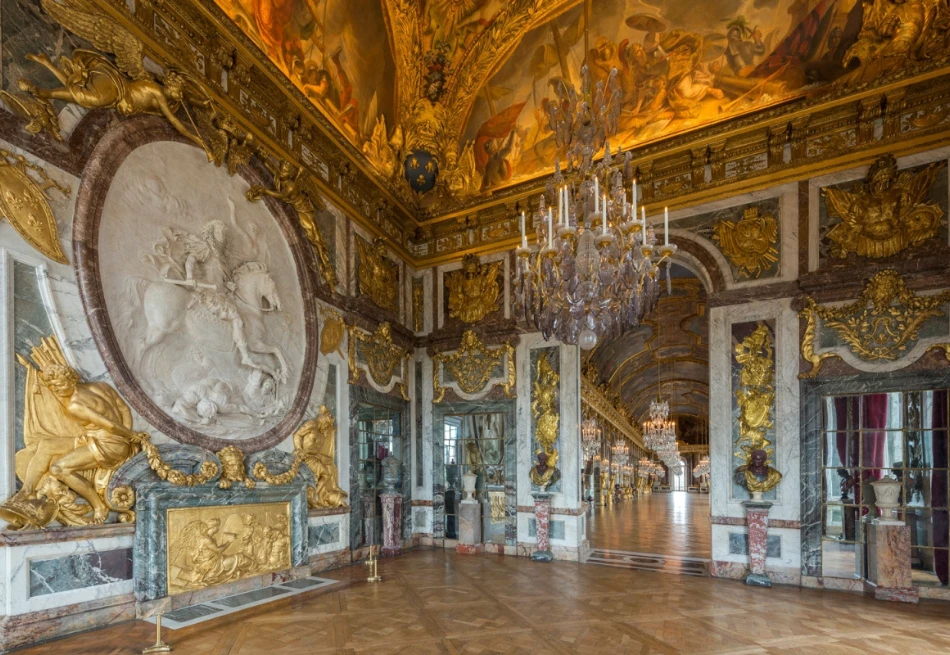
Connecting the Hall of Mirrors to the King’s State Apartments, the War Room celebrates France’s military victories. Construction began in 1678 (by Hardouin-Mansart) and was completed in 1686 (by Le Brun). The centrepiece is a large oval bas-relief of Louis XIV on horseback, flanked by defeated enemies. The ceiling depicts France Thundering Her Enemies, and the walls are adorned with gilded bronze carvings featuring the king’s emblems, trophies, and shields.
The Peace Room (Salon de la Paix)
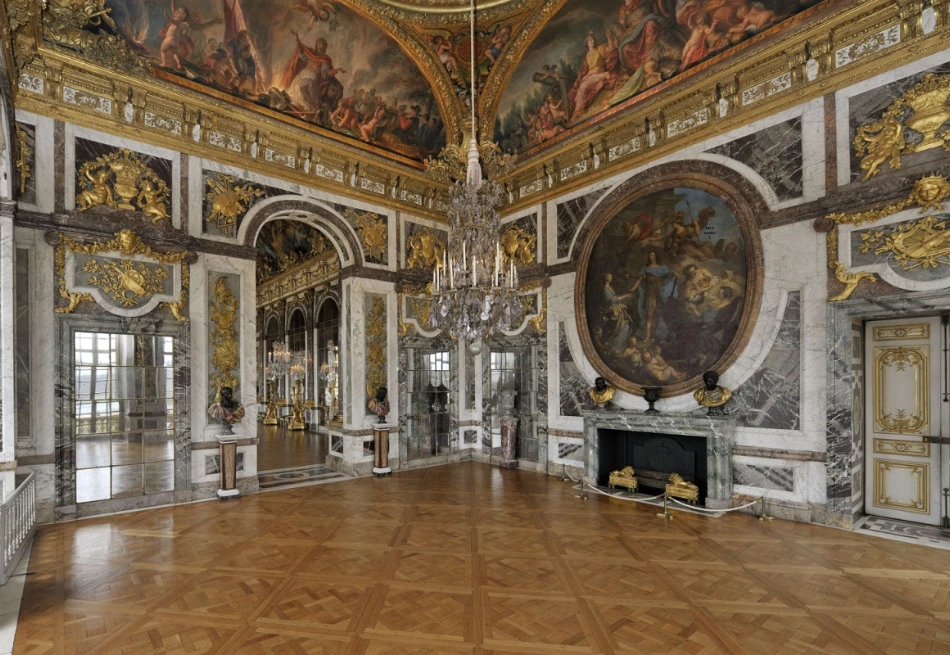
At the opposite end of the Hall of Mirrors, the Peace Room forms part of the Queen’s Apartments. Symmetrically opposite the War Room, it depicts France offering peace to Europe — with paintings showing the acceptance of peace by Germany, Holland, and Spain. During Louis XIV’s reign, the room was used for musical concerts and games.
Best Time to Visit the Hall of Mirrors
The Hall of Mirrors is most beautiful and least crowded before 10 am. In the first 30–45 minutes after the palace opens at 9 am, natural light floods the gallery from the west, the reflections are at their most spectacular, and you can actually move freely and take in the details. By 10:30 am, the gallery is typically packed wall to wall.
If you can’t make it early, late afternoon (after 3:30 pm) is the next best window — day-tripper groups have usually finished by then. See our best time to visit guide for a full breakdown of crowd patterns throughout the day.
Photography Tips
The Hall of Mirrors is one of the most photographed rooms in the world — and getting a good shot takes some planning. Arrive before 9:15 am for the least-crowded frames. Shoot towards the garden windows for the best natural light. The mirrors make wide-angle shots particularly rewarding. Flash photography, tripods, and selfie sticks are not permitted inside the palace. For more photography advice across the whole estate, see our Versailles photography guide.
How to Visit the Hall of Mirrors
The Hall of Mirrors is included in all standard Versailles tickets. The Full Access Ticket (€32) covers the palace, gardens, and Trianon Estate. The Skip-the-Line Guided Tour (from €63) includes the Hall of Mirrors as part of the guided palace route, with priority access through Entrance B.
The Hall of Mirrors is on the first floor of the main palace, accessed from the King’s Apartments on one side and the Queen’s Apartments on the other. You’ll naturally pass through it as part of the standard palace tour route. Audio guides (available from the Dufour Pavilion) include detailed commentary on the ceiling paintings and the historical significance of each section.
Is the Hall of Mirrors included in the standard ticket?
Yes — the Hall of Mirrors is included in all standard Versailles entry tickets, including the Full Access Ticket (€21 palace-only, €32 full access). No additional ticket is required.
Are the mirrors original?
Most mirrors are original from the 17th century and have been carefully preserved. Some damaged mirrors have been replaced over time. Creating the original 357 mirrors was a major technical achievement — France had to attract Venetian artisans to produce them, as Venice held the monopoly on mirror-making at the time.
Why was the Treaty of Versailles signed in the Hall of Mirrors?
The choice was deliberate and symbolic. In 1871, Kaiser Wilhelm I was proclaimed Emperor of Germany in the Hall of Mirrors following France’s defeat in the Franco-Prussian War. In 1919, French Prime Minister Clemenceau chose the same room for Germany’s surrender — signing the Treaty of Versailles in exactly the spot of France’s earlier humiliation.
